
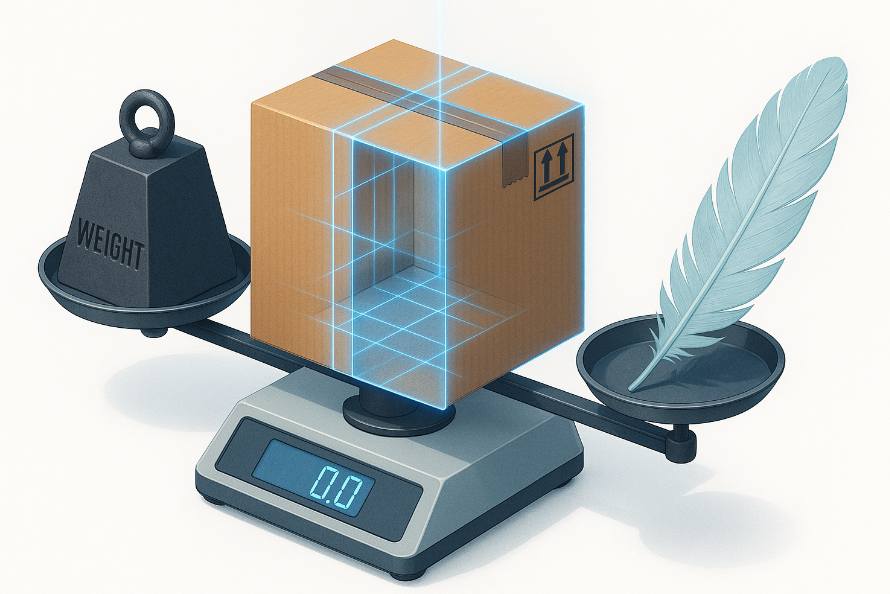
It is the silent profit killer of the e-commerce world. You sell a product, calculate your margins, and ship it off—only to find that the shipping cost is double what you estimated. The culprit? It’s not the weight of your item; it’s the air inside the box.
This is the reality of Volumetric Weight (also known as Dimensional Weight). In the logistics industry, space is currency. This guide will teach you exactly how carriers charge you, the math behind the madness, and actionable strategies to slash your shipping bills by up to 40%.
Contents
1. The “Feather vs. Lead” Paradox
Imagine a cargo plane. It has a maximum weight limit (lift capacity) and a maximum volume limit (cargo hold space).
- If the plane is filled with lead bricks, it will reach its weight limit long before it is full.
- If the plane is filled with pillows, it will be completely full but weigh almost nothing.
For decades, carriers lost money on light, bulky items. To fix this, they introduced Volumetric Weight. They decided that a specific amount of space should cost a minimum amount of money, regardless of how light the package is.
Today, virtually every major carrier—FedEx, DHL, UPS, USPS—uses this pricing model. Ignorance of this rule is the primary reason why new e-commerce businesses fail to become profitable.
2. The Math: How Carriers Calculate Your Bill
The formula varies slightly depending on whether you are shipping domestically or internationally, but the core concept is the same. You multiply the dimensions and divide by a “Divisor” (DIM Factor).
The Standard International Formula
For most international express shipments (e.g., DHL Express), the formula is:
Note: Some domestic carriers use a divisor of 6000 or even 4000. Always check your carrier’s terms.
Example Calculation
Let’s say you are shipping a large plush toy.
- Actual Weight: 2 kg
- Box Dimensions: 50 cm × 40 cm × 30 cm
Step 1: Calculate Volume
50 × 40 × 30 = 60,000 cubic cm.
Step 2: Apply Divisor
60,000 ÷ 5000 = 12 kg
The carrier looks at the Actual Weight (2 kg) and the Volumetric Weight (12 kg). They will bill you for 12 kg.
3. Chargeable Weight: The Greater of Two Evils
This is the most critical concept to understand. The “Chargeable Weight” is simply the higher of the two numbers.
| Scenario | Item Type | Actual Wgt | Volumetric Wgt | You Pay For |
|---|---|---|---|---|
| A | Books (Dense) | 10 kg | 5 kg | 10 kg |
| B | Pillows (Bulky) | 2 kg | 8 kg | 8 kg |
In Scenario B, you are paying for 6 kg of “phantom weight.” That is purely paying for the air inside the plane.
📦 Don’t Do The Math Manually
Why risk a calculation error? Enter your box dimensions into our tool and instantly see if you are being charged for Volume or Weight.
4. Strategic Packing: Stop Shipping Air
Once you understand that Volume = Money, you can start optimizing. Here are three professional strategies to reduce costs.
1. The “Cut-Down” Method
Never leave more than 2cm of headroom in a box. If you have a standard box that is too tall for the item, use a box cutter to score the corners and fold the flaps down lower. Reducing a box’s height by just 5cm can save you significantly on international shipments.
2. Poly Mailers over Boxes
For clothing, backpacks, or non-fragile items, never use a cardboard box. Boxes act as a rigid cage that guarantees a fixed volume. A poly mailer (plastic shipping bag) conforms to the shape of the item, removing all excess air volume.
3. Vacuum Sealing
If you are shipping textiles, jackets, or plush toys, vacuum sealing is mandatory. It can reduce the volume of a fluffy jacket by 70%, directly translating to a 70% reduction in shipping costs.
5. Tool: Calculate Before You Ship
Logistics is a game of precision. A guess is a gamble with your profit margin.
Before you print that label or quote a price to a customer, measure your package. Use the WiseChecker Shipping Calculator to determine the chargeable weight. If the Volumetric Weight is higher than the Actual Weight, ask yourself: “Can I make this package smaller?”
In the shipping business, the smallest box wins.